Cultural Capital
The Beast may be a recluse, but he has a lot of cultural capital. He is in the upper class and has a certain amount of prestige, as he is a prince. His cultural capital falls largely into the objectified state, as described in the video above. He has many things and people (turned into things) surrounding him that translate into a large cultural capital. The Beast says in the film that he learned to read when he was young but it has been so long that he has forgotten. Belle teaches him to read again and that gives him another form of capital, embodied state.
Belle has a large amount of embodied state cultural capital, because of all of the books that she reads. This does not translate well in her society because she is seen as strange for reading, he father is seen as the town loon and they do not appear to have many material things.
Power Structures
From a Foucauldian perspective, there are two types of power: sovereign power and disciplinary power. Defined by Covaleskie (1993), sovereign power is that “form of power expressed in recognizable ways through particular and identifiable individuals” (Cope-Watson, personal correspondence). Since the Beast is a prince, he does hold this form of power.
Disciplinary power, also defined by Covaleskie, 1993, is the power that controls through an impersonal and invisible gaze. It exerts pressures on bodies to conform and to normalize (Cope-Watson, personal correspondence). The Beast has a magic mirror in which he can view Belle at any time he wants. This is an example of the power technique surveillance in action.
Intersectionality
Intersectionality is, in simple terms, the relation of different social identity structures in fostering life experience (Gopaldas, 2013). For example, I live at an intersection of being Caucasian, being female, being able-bodied, being middle-class, being straight, being English-first language, etc. You can find your own intersectionality score here.
The characters present in Beauty and the Beast are not examples of intersectionality of oppression. Belle is, similarly to me, Caucasian, female, able-bodied, middle-class, and straight. I found Belle’s intersectionality score on the above linked website. Obviously, I had to make some assumptions. I assumed that she is cisgendered, Christian, French first language, younger, middle class, and not Muslim or Jewish. Belle’s intersectionality score was 32, with 63% of others being more privileged than her.
I also calculated the Beast’s intersectionality score. He ranked as more privileged than 73% of others. This is a test based in Canada, if it were based in France we can assume that both Belle’s score and the Beast’s score would go up.
For both Belle and the Beast, their intersectionality does not come with a system of “interlocking oppressions” but rather intertwining privilege (Dahmoon, 2011).
Gender
“Our culture allows for only two genders, and anyone who doesn’t fit one or the other is perceived as an outsider” (Johnson, 2017, p.17).
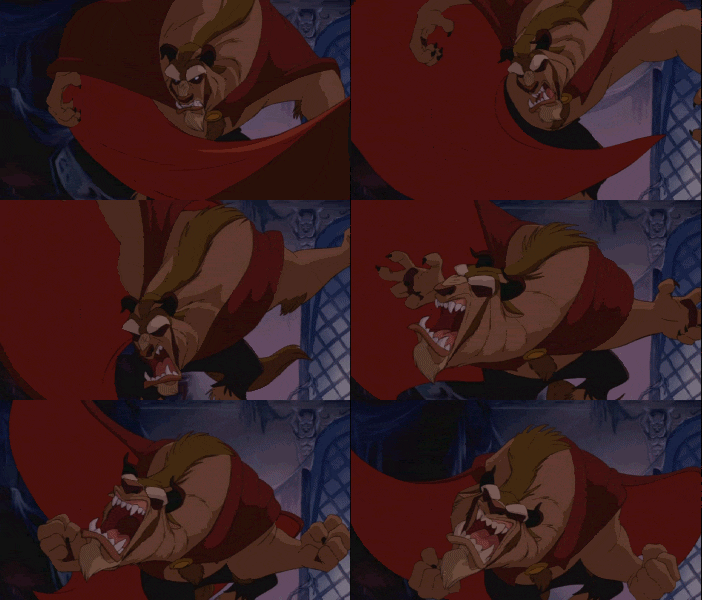
In this film, toxic masculinity is at the forefront with the character Gaston, and to a certain degree with the Beast as well. In the film we see a range of male characters, from the more effeminate Lumiere and LaFou to extremely masculine Gaston. These few portrayals of males illuminate the concept of gender order, developed by masculinity theorists, specifically Raewyn Connell. Gender order refers to the dominant definitions of masculinity and femininity and the normative patterns of gender relations between, and among, women and men at the level of a whole society (Abedinifard, 2016).
The women in the film are in traditionally femininized roles, mainly waitresses and maids but also Belle as a teacher.
Males in the film, Beauty and the Beast, seem to encourage quick marriages and giving rightful power to the dominant male in the group. It seems that they are “subordinating those girls who do not measure up to their standards of acceptable femininity” (Martino & Palllotta-Chiarolli, 2007). There is rumour that this story was originally intended to make girls see that arranged marriages aren’t so bad. There is also rumour that Belle is the first feminist Disney princess. These two thoughts are so different from each other, it makes me wonder how a story told to make girls accept their fate without a choice can be turned into a film with a feminist heroine.
A diversity perspective could be an asset in any future remakes of this film, of ensuring that all walks of life are seen and heard. The feminist pedagogy could lend a hand in making said film. Ensuring that all voices are heard, acknowledging that mastery is not required and the dominant/subordinate relationship is minimized (Cope-Watson, personal correspondence).

 Critical Review